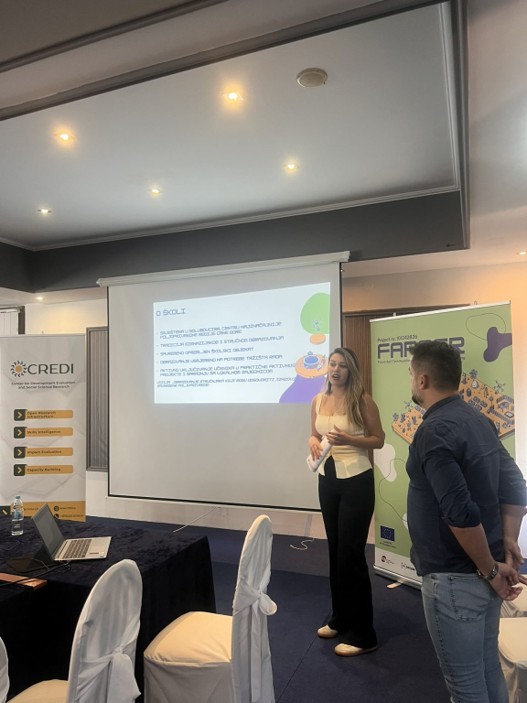
How can young people be prepared to use modern technologies in agriculture while ensuring that their education meets labour market needs? This was the focus of a series of informal consultations organised by the partner vocational schools involved in the FARMER project: JU MSŠ “Enver Pozderović” Goražde and JU Centar srednjih škola Trebinje (Bosnia and Herzegovina), and JU Srednja mješovita škola Golubovci (Montenegro). The consultations brought together representatives of Agri-Tech and other innovative companies, agricultural producers, experts, and other local stakeholders.
Participants were almost unanimous in highlighting that agriculture is undergoing a rapid digital transformation and that education programmes must keep pace with the changes driven by emerging technologies. Particular emphasis was placed on strengthening knowledge and skills related to digital tools, precision agriculture, smart machinery, automation, and other Agri-Tech solutions that are becoming an integral part of modern agricultural practice.
Participants also stressed the importance of providing students with more practical learning opportunities through cooperation with companies and other employers, enabling them to become familiar with modern working methods and technologies before entering the labour market. In addition to technical knowledge, the consultations highlighted the need to foster responsibility, communication, teamwork, entrepreneurial thinking, and a commitment to lifelong learning.
These consultations represent one of the activities carried out within the FARMER project, which aims to strengthen the capacity of vocational schools to develop modern curricula aligned with labour market needs through cooperation among European and regional partners. Working together, the project partners: Fondazione Giacomo Brodolini (Italy), Re:People – Centre for Society and Technology (Serbia), Centre for Development Evaluation and Social Science Research – CREDI (Bosnia and Herzegovina), the Rural Development Network of Montenegro, and the partner vocational schools are developing and testing improved curricula, strengthening cooperation between education providers and industry, and exchanging European experiences in modernising vocational education. The recommendations gathered through these local consultations will be used in the next phases of the project to develop new learning modules and curricula that will better prepare students for the future of work in agriculture.