Digital transformation is changing agriculture faster than the rules, institutions and everyday practices that should support it. As public registers, eAgrar, LPIS, sensors, drones, GPS machinery, satellite systems, digital platforms and agri-tech applications become part of agricultural production and administration, data is becoming one of the key resources of modern farming.
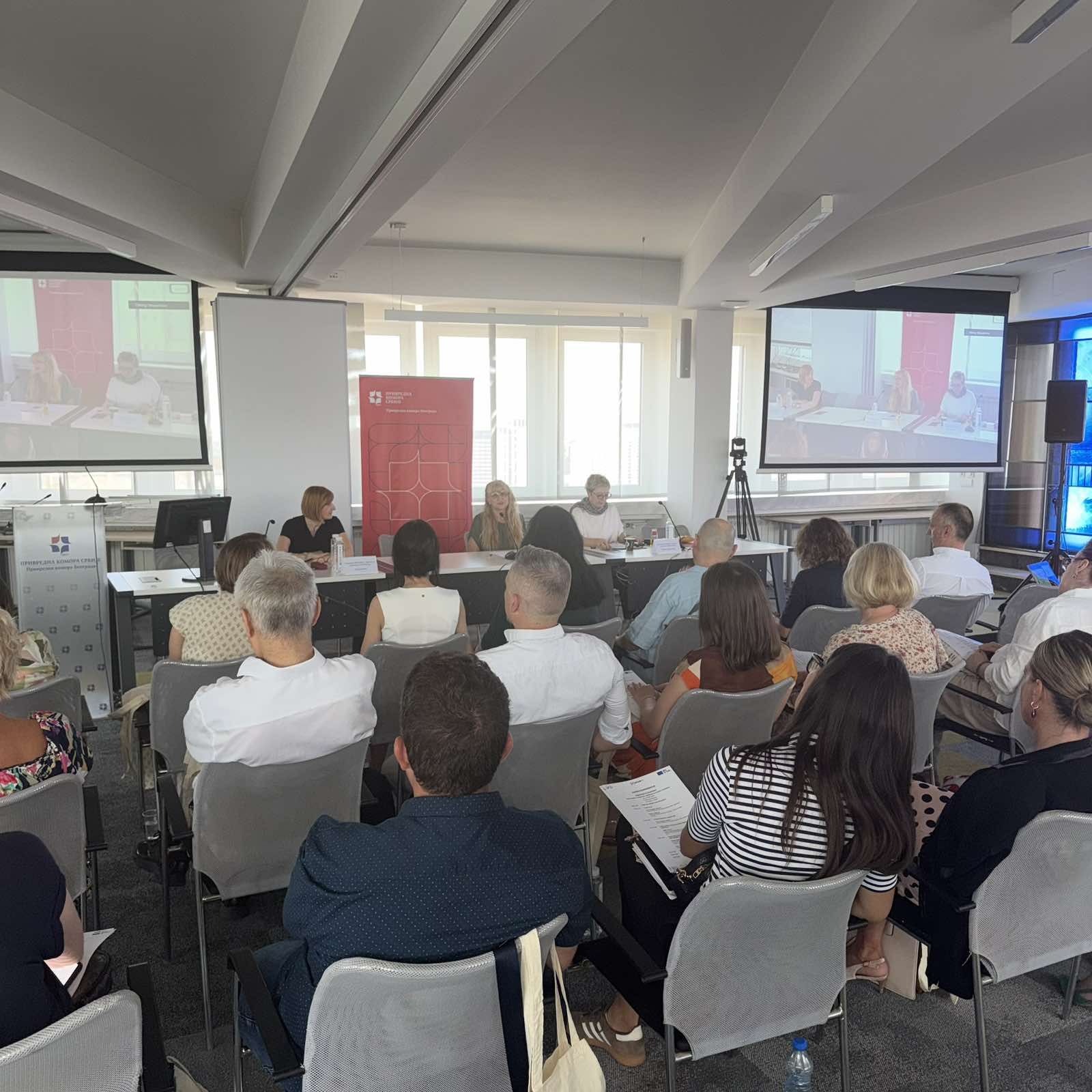
This was the central message of the conference “Digitalisation with Trust: Data Protection in Agriculture and Alignment with European Standards”, held on 25 June 2026 at the Belgrade Chamber of Commerce. The event was organised by Re:People – Centre for Society and Technology, in cooperation with the Institute for Science Application in Agriculture, the Smart Agriculture Council of the Chamber of Commerce of Belgrade, and the Group for Advisory Services and Knowledge Transfer of the Chamber of Commerce and Industry of Serbia.
The conference brought together representatives of institutions, agricultural advisory services, data protection experts, researchers, civil society organisations and actors involved in the development of digital and smart agriculture. The discussion focused on a practical but increasingly strategic question: how can agricultural data be collected, used and exchanged in a way that strengthens innovation, productivity and public services, while protecting farmers’ rights, security and trust?
The event presented the findings of the project “Digitalisation with Trust: Towards Data Protection in Agriculture”, implemented by Re:People. The research included a mapping of 247 actors in Serbia’s smart agriculture ecosystem, desk and legal analysis of the national and European framework, and four focus groups with farmers in Požarevac and Jagodina.
The findings show that digital technologies are already present in agricultural practice, but their use remains uneven. Around half of the farmers included in the research use some form of digital technology, while most have not received formal education or training for its use. In everyday communication, Viber and Facebook remain dominant channels, while email and digital public services are used less frequently.
This gap is important. Farmers are increasingly expected to use digital systems and provide data, but often without a clear understanding of who can access those data, for what purposes, under which rules, and with what consequences. In practice, data protection is rarely understood through the formal language of legal compliance. Farmers speak instead about the risks they recognise directly: misuse, fraud, data leaks, loss of control and uncertainty about who benefits from the data they provide.
For smart agriculture, this is not a marginal issue. Trust is becoming a condition for adoption. If farmers do not understand digital systems, if they do not know how their data are used, or if they fear that information about their farms can be misused, digitalisation may remain partial, formal or resisted. The same applies to advisory services, which are often the first point of contact between farmers and institutions. Their role is no longer only technical or agronomic. They are increasingly becoming mediators of trust between farmers, public systems and digital tools.
At the conference, Prof. Dr Snežana Janković, Assistant Director for Science at the Institute for Science Application in Agriculture, opened the discussion by placing agricultural digitalisation in a broader institutional and developmental context. Branka Anđelković, Co-founder and Programme Director of Re:People, presented the key project findings and underlined that data are becoming a strategic resource of agriculture. Zlatko Petrović, a data protection expert with long-standing experience in the Office of the Commissioner for Information of Public Importance and Personal Data Protection, explained the basic legal principles of data processing in the context of agriculture, including legal basis, rights of data subjects, obligations of controllers and processors, data protection impact assessment and the role of data protection officers. Tanja Jakobi, Executive Director of Re:People, presented the project recommendations and pointed to the need for Serbia to prepare in time for the new European data framework, including GDPR, the Data Governance Act, the Data Act, the AI Act and the future European agricultural data space.
The project recommendations call for a more systematic approach to data governance in agriculture. Serbia needs clear rules on who collects agricultural data, who has access to them, for what purposes they are used and what rights farmers have. Digital public services in agriculture should be designed with privacy and security built in from the start, not added later as a formal requirement. Advisory services need training in data protection, digital security and the use of eAgrar, while farmers need simple guides and short practical training on passwords, fraud prevention, account protection and reporting misuse.
The recommendations also point to the need for sector-specific guidance from the Commissioner for Information of Public Importance and Personal Data Protection. General data protection rules should be translated into concrete agricultural situations: eAgrar, advisory services, cooperatives, agri-tech applications, drones, sensors and digital platforms. Schools, faculties and training programmes should include data protection and digital security, so that future agricultural professionals understand not only production, but also the data systems, artificial intelligence and risks that increasingly shape the sector.
For the Smart Labor agenda, these findings are directly relevant. The development of smart agriculture is not only a question of technology. It is also a question of skills, institutions, rights and policy coordination. Farmers, advisers, public authorities, agri-tech companies, researchers and civil society need a common space to discuss new risks, European rules and the practical needs of agricultural producers. One of the project’s key recommendations is therefore to establish a permanent forum on data and digital agriculture.
The conclusion of the conference was clear: digitalisation can bring important benefits to farmers, institutions and the economy, but only if trust, legal certainty, digital competences and data protection develop at the same time. Without that, digital agriculture risks becoming another layer of administrative pressure. With it, data can become a resource that supports better services, stronger innovation and more resilient rural development.
The conference was organised as part of the project “Digitalisation with Trust: Towards Data Protection in Agriculture”, implemented by Re:People – Centre for Society and Technology. The project is implemented within the EU Resource Centre for Civil Society in Serbia, led by the Belgrade Open School in partnership with civil society organisations and supported by the European Union.